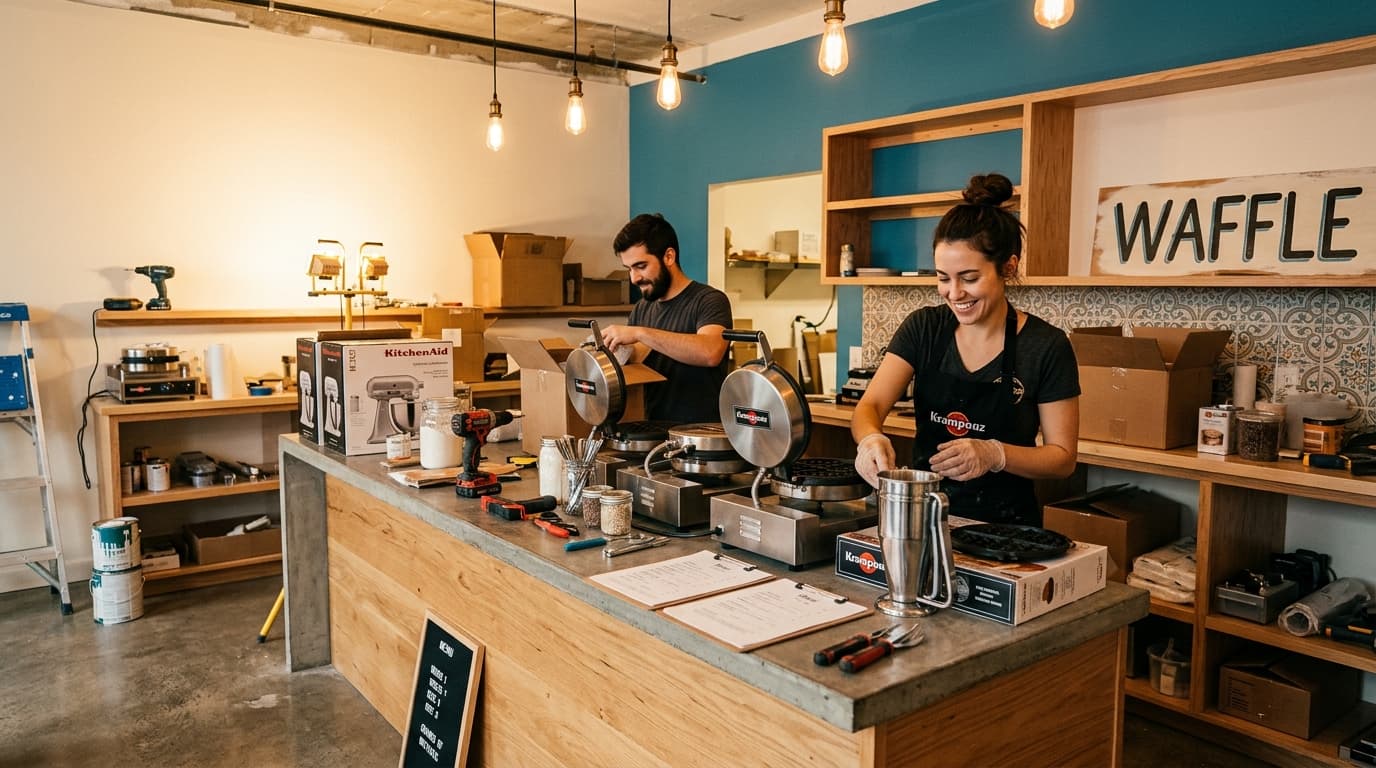
You have probably been googling waffle franchise options for the last week. Maybe you have a spreadsheet going. Maybe you have already called a couple of brands. But you are still stuck on the big question: where do I actually begin?
This guide is going to walk you through every step of starting a waffle franchise in India. Not the theoretical version you read on franchise listing sites. The real version, with actual timelines, license costs, and the mistakes that trip up first-time franchise owners.
Let us get into it.
Why Waffles? The India Dessert Market in 2026
Before you invest a single rupee, you should understand why waffles specifically. Not just because they taste good, but because the economics work.
India's organised dessert market is worth over Rs 33,000 crore and growing at 7.4% annually. That is faster than the overall food service industry. But here is the real insight: only about 8-10% of this market is organised. The rest is local bakeries, sweet shops, and unbranded stalls.
That gap between demand and organised supply is where the opportunity lives.
Three trends are pushing this forward:
Instagram culture. Waffles photograph beautifully. A well-plated Belgian waffle generates organic social media content in a way that samosas and chai never will. This matters because your customers do your marketing for free.
Tier 2 and 3 expansion. Cities like Lucknow, Chandigarh, Indore, and Jaipur now have the spending power for premium desserts but almost no branded options. The first good waffle outlet in a tier 2 city often has zero direct competition.
Low operational complexity. Compared to a full restaurant, a waffle operation needs fewer staff, less kitchen space, and simpler equipment. A trained operator can start producing within days, not months.
Franchise vs Starting from Scratch: The Honest Comparison
This is the first real decision you need to make. And most online guides skip over it because they are trying to sell you a franchise.
Here is the truth. Both paths can work. But they work for different people.
| Factor | Franchise | Independent |
|---|---|---|
| Startup cost | Rs 3-15 lakh (depending on brand) | Rs 2-8 lakh (depends on scale) |
| Brand recognition | Immediate | Takes 6-12 months to build |
| Menu development | Done for you | You figure it out |
| Supply chain | Established | You source everything |
| Marketing support | Provided | You are on your own |
| Failure rate | Around 15-20% | Around 60-80% in year one |
| Creative control | Limited | Complete |
| Ongoing costs | Royalty (4-8%) | None |
The numbers do not lie. Independent food businesses in India have a brutal failure rate in the first year. Most fail not because the food is bad, but because of operational problems: inconsistent supply, no brand pull, poor location choice, and running out of working capital.
A franchise solves most of these problems. You trade some creative control and pay a royalty for a proven system that reduces your risk significantly.
When independent makes sense: You have food industry experience, a strong local reputation, and a unique concept. If you have run a food business before and know the supply chain, going independent gives you more control and better margins long-term.
When franchise makes sense: You are new to the food business, have limited time for trial and error, and want a faster path to revenue. This is most people.
Step 1: Research Waffle Franchise Brands
Do not just pick the first brand that shows up on Google. Spend a week comparing at least 3-4 options. Here is what to compare:
Total investment. Not just the franchise fee. Ask for the complete cost including equipment, setup, branding, and initial inventory. Brands like TBWX start at Rs 4 lakh all-in for a kiosk. Others range from Rs 7-15 lakh.
Royalty structure. Monthly royalties typically range from 4-8% of revenue. Some brands waive royalties for the first year to help you get established. Ask specifically about this.
Territory exclusivity. Will you be the only outlet in your area? What radius of protection do you get? A franchise without territory exclusivity means the brand could open another outlet 500 metres from you.
Training and support. How many days of training? Is it at your location or theirs? What happens after training ends? Do you get ongoing support or are you on your own?
Menu flexibility. Can you add local items? Can you adjust prices for your market? Rigid menus can be a problem in smaller cities where pricing needs to be different from metros.
Red flags to watch for
High franchise fees with vague support promises. If they want Rs 5 lakh as a franchise fee but cannot clearly explain what you get for it, walk away.
Locked-in suppliers at inflated rates. Some brands force you to buy ingredients only from their approved suppliers at prices 20-30% above market. This kills your margins.
No existing franchisees to speak to. Any good brand will connect you with current franchise owners. If they refuse or make excuses, that tells you everything.
Pressure to sign quickly. Good opportunities do not disappear overnight. If a brand is pushing you to sign within a week, they are more desperate than they are letting on.
Step 2: Evaluate Your Budget and Location
Budget by format
| Format | Investment | Space needed | Best for |
|---|---|---|---|
| Cart/Mobile | Rs 2-3 lakh | No fixed space | Events, markets, college campuses |
| Kiosk | Rs 4-5 lakh | 60-100 sq ft | Malls, high streets, food courts |
| Cafe | Rs 8-15 lakh | 300-600 sq ft | Standalone store with seating |
Most first-time franchise owners go with the kiosk model. It has the best balance of cost, visibility, and revenue potential.
Choosing your location
Location is the single biggest factor in whether your franchise succeeds or fails. Here is how to evaluate one:
Footfall count. Stand at the location for 2-3 hours during peak time (5-9 PM for desserts). Count the people walking past. You want at least 200-300 people per hour for a kiosk model.
Competition radius. Check Google Maps for other dessert outlets within 1 km. Some competition is fine. It means there is demand. No competition at all might mean there is no demand.
Rent to revenue ratio. Your rent should not exceed 15-20% of your projected monthly revenue. If rent is Rs 25,000, you need to be confident of doing Rs 1.5 lakh or more in monthly sales.
Visibility. Ground floor, facing the main road, with clear signage opportunity. A first-floor or basement location will cost you 30-50% of potential walk-in customers.
Best locations for waffle outlets: College areas (consistent young crowd), mall food courts (high footfall, built-in audience), commercial streets in tier 2 cities (low rent, aspirational demand), and transit hubs (railway stations, bus stands).
Step 3: Apply and Sign the Franchise Agreement
Once you have picked a brand and location, the application process typically goes like this:
1. Submit an inquiry. Most brands have online forms. You share your city, budget, and preferred location.
2. Discovery call. The brand's franchise team calls you to discuss your background, expectations, and timeline. This is also your chance to ask questions.
3. Location review. Good brands will review your proposed location and give feedback. Some will help you find one.
4. Franchise agreement. This is the legal document that defines your relationship. Read every page.
Key terms to check in the agreement
Territory definition. How is your exclusive territory defined? By pin code, radius, or city zone?
Exit clause. What happens if you want to close after 1 year? What is the penalty? Can you sell to someone else?
Royalty escalation. Does the royalty percentage increase over time? Some agreements have escalation clauses buried in the fine print.
Renewal terms. What happens when your initial agreement period ends? Is renewal automatic or renegotiated?
Performance minimums. Are there minimum sales targets you must hit? What happens if you do not?
Get a lawyer to review the agreement. A one-time Rs 5,000-10,000 legal review can save you from a bad deal.
Step 4: Get Your Licenses
This is the part that scares most first-timers. It is actually not that complicated. Here is every license you need and exactly how to get each one:
FSSAI License
What: Food Safety and Standards Authority of India registration or license
Cost: Rs 2,000-5,000 (registration for small businesses) or Rs 7,500 for a state license
Timeline: 30-60 days
How: Apply online at foscos.fssai.gov.in. You need identity proof, address proof, and a food safety plan. Most franchise brands help you with the application.
GST Registration
Cost: Free
Timeline: 7-10 working days
How: Apply at gst.gov.in. You need your PAN card, Aadhaar, bank account details, and your business address proof. Mandatory if your turnover exceeds Rs 20 lakh (Rs 10 lakh for special category states).
Trade License
What: Permission from your local municipal corporation to operate a business
Cost: Rs 500-5,000 (varies by city)
Timeline: 15-30 days
How: Visit your local municipal office or apply online through your city's municipal website.
Shop and Establishment Registration
Cost: Rs 500-2,000
Timeline: 15-30 days
How: Apply through your state's labour department. This is mandatory within 30 days of starting operations.
Fire Safety Certificate
Cost: Rs 1,000-3,000
Timeline: 7-15 days
How: Apply to your local fire department. They will inspect your premises. For a small kiosk, this is usually straightforward.
Total license cost: Rs 5,000-15,000. Total timeline: 45-90 days if you start early.
Pro tip: Start your license applications while your outlet is being set up. Do not wait until the store is ready. Running the two processes in parallel saves you 4-6 weeks.
Step 5: Set Up Your Outlet
With a franchise, most of the setup is guided by the brand. Here is what typically happens:
Store design. The brand provides design templates, signage specifications, and layout plans. You hire a local contractor to execute. Some brands like TBWX send their own team to supervise setup.
Equipment. The brand tells you exactly what to buy and where to buy it. For a waffle kiosk, you need: waffle makers (1-3 depending on format), a refrigerator, a display counter, basic utensils, and packaging materials. Total equipment cost: Rs 50,000-1.5 lakh.
POS system. Most brands provide or recommend a point-of-sale system. This tracks your sales, inventory, and helps with accounting. Monthly cost: Rs 500-1,500 for cloud-based systems.
Initial inventory. Your first stock of batter mix, toppings, sauces, packaging, and disposables. Budget Rs 15,000-30,000 for your initial inventory order.
Delivery platform setup. Get listed on Swiggy and Zomato before your opening day. The onboarding process takes 7-14 days, so start this early. Delivery can account for 30-50% of your revenue, especially in the first few months.
Step 6: Launch and Start Selling
Opening day matters more than you think. A strong launch creates momentum that carries you through the critical first 3 months.
Grand opening ideas that actually work
Free waffle hour. Offer free waffles for the first hour on opening day. It creates a queue, which creates curiosity, which creates social media posts. Cost: Rs 3,000-5,000 in product. Value: priceless word-of-mouth.
Instagram launch. Get 5-10 local food bloggers to visit before your official opening. One good reel from a blogger with 10,000 followers can drive 100+ customers in a week.
Opening day combo. A special combo price (buy 1 get 1, or waffle plus shake for Rs 99) that is only available on opening day. Creates urgency and gets people to try multiple items.
Your first 90 days checklist
Week 1-2: Focus on operations. Get your team comfortable with the menu, speed, and consistency. Mistakes are fine. Speed will come.
Week 3-4: Turn on delivery platforms. Start with a limited menu on Swiggy and Zomato. Expand as you get comfortable.
Month 2: Start tracking daily numbers religiously. Revenue, food cost percentage, customer count, average order value. If you are not measuring, you are guessing.
Month 3: Evaluate what is selling and what is not. Adjust your display, promote bestsellers, and consider dropping items that do not move. Share your numbers with your franchise brand. They can spot problems you might miss.
Common Mistakes First-Time Franchise Owners Make
After working with dozens of franchise owners, these are the patterns we see again and again:
Choosing location based on cheap rent. A Rs 8,000 rent location with no footfall will lose more money than a Rs 20,000 location with strong walk-in traffic. The rent savings never make up for lost sales.
Underestimating working capital. Your outlet will not be profitable from day one. Keep at least 2 months of operating expenses (rent, staff salary, inventory, utilities) as a buffer. For a kiosk model, that is Rs 50,000-1 lakh.
Ignoring delivery platforms. Some owners think walk-in traffic is enough. In 2026, it is not. Delivery platforms are how most urban consumers discover new food brands. If you are not on Swiggy and Zomato within your first month, you are leaving 30-50% of potential revenue on the table.
Trying to change the menu in month one. Trust the franchise system for the first 3-6 months. The menu exists because it has been tested across multiple locations. Make changes only after you have data on what your specific market wants.
Not tracking daily numbers from day one. If you do not know your daily revenue, food cost percentage, and customer count, you cannot identify problems until they become crises. Fifteen minutes of bookkeeping per day prevents 90% of financial surprises.
Frequently Asked Questions
How long does the entire process take from application to opening?
Typically 45-90 days. The application and agreement phase takes 1-2 weeks. Licenses take 4-6 weeks (run in parallel with setup). Outlet setup takes 2-4 weeks depending on how much renovation is needed. If you start license applications early and have a location ready, some operators have launched in as little as 30 days.
Can I run a waffle franchise part-time?
Yes, especially with the kiosk and cart models. You will need a trained staff member to handle operations when you are not there. Most kiosk franchise owners spend 4-5 hours per day at the outlet during the first month, then reduce to 2-3 hours once the team is trained. Your franchise brand's POS system lets you monitor sales remotely. We have a full guide for salaried professionals running a franchise as a side business if this is your situation.
What if my city already has a franchisee from the brand I want?
It depends on the brand's territory policy. Some brands allow multiple outlets in the same city if they are in different zones. Others maintain strict territory exclusivity. Ask the brand directly how they define territories. If your preferred brand is taken, consider whether a competing brand or a different area of the same city might work.
What is the minimum space required?
For a kiosk: 80-150 sq ft. For a cart: no fixed space needed. For a cafe: 300-600 sq ft. The kiosk model is the most popular because it works in mall corners, market streets, and food courts without requiring a large dedicated shop.
Do I need food industry experience?
No. That is one of the main advantages of a franchise model. The brand provides complete training covering food preparation, hygiene standards, customer service, and inventory management. Most TBWX franchise owners come from completely unrelated backgrounds. Students, IT professionals, retired officers, and homemakers have all launched successful outlets.
What about ongoing royalties?
Most waffle franchises charge 4-8% of monthly revenue as royalty. TBWX charges 5% of gross sales + GST from month 1. Factor the royalty into your profit calculations from the start. On Rs 1.5 lakh monthly revenue with a 5% royalty, that is Rs 7,500 per month.
Can I own multiple outlets?
Yes. Most brands encourage multi-unit ownership. Once your first outlet is profitable and stable (usually after 6-12 months), you can discuss opening a second location. Multi-unit operators often get reduced franchise fees and better territory options.
What training is provided?
Training typically covers: recipe preparation and consistency, food safety and FSSAI compliance, POS system operation, customer service standards, inventory management, and basic marketing. Duration ranges from 3-7 days depending on the brand. TBWX provides on-site training at your location plus ongoing remote support.
What if it does not work out? What are my exit options?
Read your franchise agreement carefully for exit terms. Typical lock-in periods are 1-3 years. If you exit during the lock-in period, you usually forfeit your franchise fee. Your equipment and inventory are yours to sell. Some brands allow you to transfer the franchise to another operator, which lets you recover some of your investment. The key is to discuss exit scenarios before signing, not after.
Is franchise income taxable?
Yes. Franchise income is treated as business income under the Income Tax Act. You will file taxes as a sole proprietor or under whatever business structure you choose. GST applies if your turnover exceeds Rs 20 lakh. Keep proper books from day one. A cloud-based accounting tool like Zoho Books or Khatabook costs Rs 200-500 per month and makes tax filing simple.
Ready to Start?
Starting a waffle franchise is not complicated. It just takes clear information and a willingness to do the work. If you have read this far, you are already more prepared than 90% of people who think about starting a franchise but never act on it.
The next step is simple. Pick 2-3 brands that match your budget. Talk to their teams. Visit existing outlets. Talk to franchisees. Then make your decision.
If TBWX is on your shortlist, we would love to talk. Explore our franchise model or apply directly to check territory availability in your city. You can also read our complete 2026 waffle franchise guide for a full breakdown of investment trends, brand comparisons, and city-level demand.
You might also find these useful: