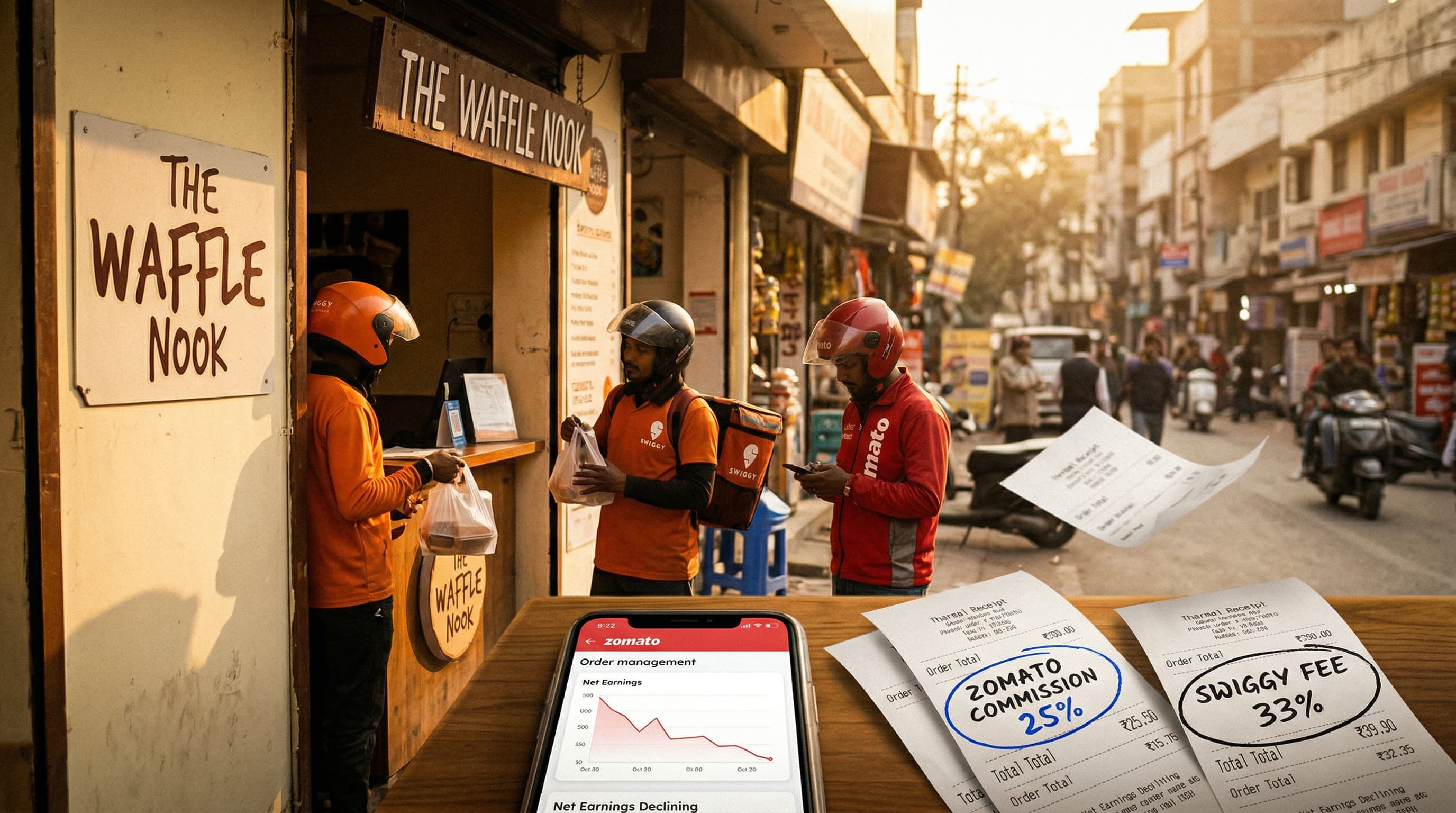
Ask any small restaurant owner in India what is killing them in 2026 and you will hear the same three words: Swiggy and Zomato.
On paper, the commission is 20-25%. In reality, after delivery charges, ad spend, discount participation, GST, and penalties, the actual takeaway for the operator is often 35-40% of the listed price. One operator on Reddit put it plainly last year: "They claim to charge a 25 percent commission, but we receive just around 35 percent of the total order value."
That is not a business. That is paying a platform to lose money on every order.
But delivery is not optional anymore. A cafe that refuses to list on Swiggy or Zomato is invisible to 40% of its potential customers. So the real question is not "should I list", it is "how do I survive listing."
At TBWX, we have been running the same math across 67 outlets for five years. Here is what works.
The Real Commission Math (Not the Brochure Version)
When a platform tells you "we charge 22% commission," they are technically telling the truth. What they leave out is everything else stacked on top.
Here is a real order breakdown for a Rs 200 waffle sold on Zomato:
| Line Item | Amount |
|---|---|
| Customer pays | Rs 200 |
| Zomato commission (22%) | -Rs 44 |
| Payment gateway fee (2.5%) | -Rs 5 |
| Platform delivery fee share | -Rs 15 |
| Discount contribution (30% off = operator share 50%) | -Rs 30 |
| Ads and promoted listing amortised | -Rs 12 |
| GST on commission | -Rs 9 |
| What the operator actually receives | Rs 85 |
Out of that Rs 85, the operator still has to pay for ingredients, packaging, labour, rent, utilities, and royalty. For a Rs 200 waffle with a Rs 60 food cost, there is almost nothing left.
Do that math for 30 orders a day and you understand why small cafes are shutting down across Pune, Bangalore, and Mumbai.
The Penalties Nobody Warns You About
Commissions are the visible pain. The hidden pain is the penalty structure.
Rate parity fines: If your dine-in price is lower than your Zomato price, platforms can fine you up to Rs 1 lakh. You cannot even legally undercut them in your own shop.
Rejection penalties: Reject an order because you ran out of stock? Platform cuts your visibility or charges a flat rejection fee.
Rating drops: One bad review because a delivery rider was late (your fault, somehow) can cut your impressions by 40% overnight.
Mandatory ad spend: To stay visible in your locality, you are pushed into "sponsored listings." Operators report spending Rs 8,000-15,000 per month on ads just to not disappear from the app.
This is why the TBWX operations playbook treats aggregators as a channel, not a strategy. You use them. You do not depend on them.
The Dine-In vs Delivery Mix That Actually Works for Desserts
Here is a rule we learned the hard way across 67 outlets: for a dessert QSR, delivery should never be more than 40% of your total revenue. Ideally 25-35%.
Why? Because desserts are impulse purchases. The customer walking past your outlet at 7 PM, smelling fresh waffles, watching chocolate drizzle hit a hot iron, that customer converts at 80%. The customer scrolling Zomato at home is comparison shopping, using coupons, and rejecting orders.
A TBWX outlet in Pune runs at 65% dine-in, 25% delivery, 10% own-brand WhatsApp orders. An identical outlet in Lucknow runs 55% dine-in, 35% delivery. Both are profitable. The outlets that struggle are the ones where delivery creeps above 60% because the operator stopped marketing their physical shop.
What We Do Differently (And What You Should Copy)
1. List only the items that survive delivery margin
Not every menu item should be on Swiggy. At TBWX, 40% of our dine-in menu is not listed on aggregators at all. Waffles with ice cream, dessert shakes, and loaded waffle boxes work. Standalone hot drinks and small add-ons do not, the commission eats them alive.
Run this test on every item on your menu: take the menu price, subtract 40%, subtract your food cost, subtract Rs 10 for packaging. If what remains is under Rs 30, do not list that item.
2. Build your own direct-order channel from day one
Every TBWX outlet has a WhatsApp Business number on its shopfront, receipts, and Instagram bio. Customers who order directly pay the same price, but we keep 100% of the revenue instead of 60%.
It takes six months to build this habit, but once you have 300 repeat customers ordering on WhatsApp, you have effectively bought yourself out of Zomato dependency. This is the single highest-leverage move any small cafe can make.
3. Price deliberately higher on aggregators
Yes, platforms fine you for being cheaper in-store. They do not fine you for being more expensive online. Every TBWX outlet lists on Swiggy and Zomato at 10-12% above the dine-in menu price. The customer ordering at home is paying for convenience, they already know that.
This one move recovers about Rs 20 on a Rs 200 item. Across 20 daily delivery orders, that is Rs 12,000 a month of pure recovered margin.
4. Say no to discount flash sales
When Swiggy calls and offers you a 50% off flash sale, the math almost never works. "Increased visibility" is a real thing for 72 hours. After that, you have trained your customers to only buy at half price, and your full-price orders collapse.
TBWX outlets participate in exactly two platform promotions a year. Valentine's Day and National Waffle Day. Both are events where footfall genuinely spikes. The rest of the year, we compete on product quality, not price.
5. Own your Google Business Profile before you touch Swiggy
Google Maps brings you walk-in customers for zero commission. A TBWX outlet with 300+ Google reviews and a well-optimised profile gets 40-50 walk-ins a day from Google search alone. That is 1,200-1,500 walk-in customers a month without paying a rupee to any platform.
Most small cafes skip this and go straight to Swiggy listings. They have got it exactly backwards.
The TBWX Outlet P&L With and Without Aggregator Discipline
Here is the same Rs 1.5 lakh/month TBWX outlet, managed two different ways:
| Line Item | Undisciplined (60% delivery) | Disciplined (30% delivery) |
|---|---|---|
| Revenue | Rs 1,50,000 | Rs 1,50,000 |
| Food cost | Rs 45,000 | Rs 45,000 |
| Packaging | Rs 10,000 | Rs 6,000 |
| Aggregator commission and fees (net) | Rs 31,500 | Rs 15,750 |
| Platform ads | Rs 12,000 | Rs 3,000 |
| Rent | Rs 18,000 | Rs 18,000 |
| Staff | Rs 18,000 | Rs 18,000 |
| Utilities, royalty, misc | Rs 16,000 | Rs 16,000 |
| Net Profit | Rs -500 | Rs 28,250 |
Same revenue. Same product. Same location. Rs 28,750 difference in the owner's pocket, just from aggregator discipline.
So Should You List on Swiggy and Zomato at All?
Yes. But treat them the way you treat a loud, overpriced supplier. You negotiate. You cap your exposure. You build alternatives.
The cafes that go out of business are the ones that hand over their entire customer relationship to the platform and hope for the best. The ones that survive, and the ones that thrive, use aggregators as one channel among four (dine-in, Google, WhatsApp, delivery) and never let any single channel exceed 40% of revenue.
The TBWX Advantage
When you join TBWX as a franchise partner, you are not figuring this out alone. Every new outlet receives our aggregator setup playbook on day one, which items to list, at what price, how to structure the menu page, which ads to run, when to opt out of promotions. It is the result of five years of testing across 67 outlets, so a new partner starts with what has already worked instead of learning it by trial and error.
See the full TBWX investment breakdown or apply to start your own outlet. If you are already running a cafe and this post made you rethink your delivery strategy, read how to pick a location that reduces your delivery dependency next.
The platforms will not fix themselves. But you can build a business that does not need them to.