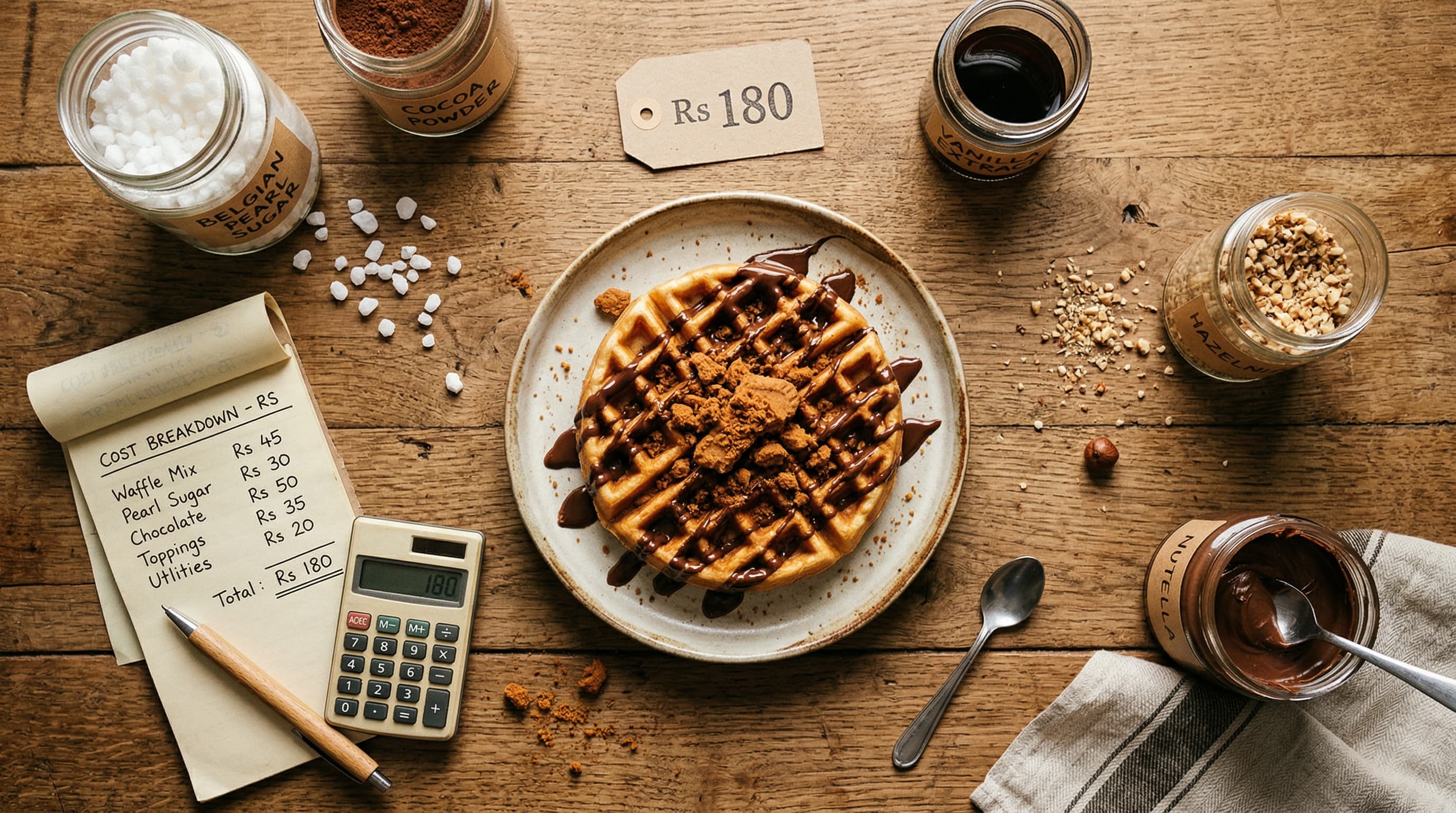
Every few weeks, someone posts a photo of a Rs 180 Belgian waffle on Reddit with a caption like "why is this so expensive, it is just maida and chocolate."
The comments split into two groups. One group agrees and mocks the price. The other group, usually people who have actually worked in food businesses, try to explain the math and get downvoted for it.
This post is for both groups.
If you are a customer: you deserve to know what you are actually paying for. You might still think Rs 180 is expensive after reading this, and that is fair. But at least you will know why.
If you are an aspiring franchise owner: this is how margin logic works in the Indian dessert QSR business. If you do not understand it, you will mispricethe moment you open your own outlet.
The Rs 180 Waffle, Line by Line
Let us take a standard Belgian waffle with Nutella and two toppings, priced at Rs 180 on the menu. Here is what is inside that number:
| Line Item | Cost | % of Menu Price |
|---|---|---|
| Belgian pearl sugar (imported) | Rs 8 | 4.4% |
| Premium flour, butter, eggs, milk (batter) | Rs 14 | 7.8% |
| Nutella and toppings | Rs 22 | 12.2% |
| Packaging (for takeaway/delivery) | Rs 6 | 3.3% |
| Electricity (waffle iron draws heavy power) | Rs 5 | 2.8% |
| Rent allocation per waffle | Rs 18 | 10.0% |
| Labour allocation per waffle | Rs 15 | 8.3% |
| Aggregator commission (averaged across channels) | Rs 18 | 10.0% |
| Royalty to brand (franchise fee) | Rs 9 | 5.0% |
| GST (collected and paid, not earnings) | Rs 9 | 5.0% |
| Total cost to operator | Rs 124 | 68.8% |
| Operator gross margin | Rs 56 | 31.2% |
And out of that Rs 56 operator margin, the owner still has to cover marketing, maintenance, wastage, utilities beyond electricity, insurance, loan repayments, and personal income tax. Net margin for the owner is typically Rs 35-42 per Rs 180 waffle. About 20-23%.
That is not a ripoff. That is a reasonable margin for a food business. Anyone telling you it should be higher has never run a small cafe.
Why Belgian Pearl Sugar Matters (And Why Cheap Waffles Skip It)
The single most underappreciated ingredient in a real Belgian waffle is the pearl sugar. These are large, coarse sugar crystals that hold their shape during baking and create the signature caramelised crunch on the waffle's exterior.
Pearl sugar is imported from Belgium and a few European suppliers. It costs roughly 8 to 10 times regular sugar by weight. A well-made Liege-style waffle uses 40-50 grams of pearl sugar per piece. That is the Rs 8 line in our breakdown.
When you see a waffle selling for Rs 80 in India, the first thing they cut is the pearl sugar. They use regular sugar, or worse, they sprinkle powdered sugar on top to mimic the crunch. The result is a soft, spongy, cake-like disc that is technically a waffle in the same way that instant coffee is technically coffee.
The cheap waffle is not a bargain. It is a different product.
Rent, Labour, and Electricity: The Invisible Costs
Ingredients are the smallest part of the waffle's price. The biggest chunk is the fixed overhead allocated per unit sold.
Rent. A decent high-footfall location in any Indian metro costs Rs 25,000 to Rs 60,000 per month. A small town location runs Rs 12,000-25,000. Across 800-1,500 waffles sold in a month, that translates to Rs 15-40 per waffle in rent allocation alone.
Labour. Two staff at Rs 12,000 each is Rs 24,000 a month, plus the owner's own time. Divide that across monthly output, and you get Rs 15-20 per waffle.
Electricity. Waffle irons are energy-intensive. A single commercial iron can draw 2.5-3 kW. A busy outlet running 4-6 irons during peak hours can rack up Rs 6,000-9,000 a month in electricity. Per waffle, that is Rs 4-6.
Together, these three fixed costs consume around 25-30% of the menu price. Even if every ingredient was free, the waffle would still need to sell for Rs 60-70 just to cover its share of the rent, staff, and power bill.
The Aggregator and Royalty Layers
On top of production costs sit two more layers that most customers never see.
Aggregator commission. If you order that waffle on Zomato or Swiggy, the platform takes 22-30% of the listed price in various forms, commission, delivery share, ad cost, discount participation. Averaged across dine-in and delivery channels, our accounting shows aggregator impact at roughly 10% of the menu price. (For the full breakdown, read how Swiggy and Zomato eat small restaurant margins.)
Franchise royalty. For a branded waffle, the operator pays the brand 5-7% of revenue as an ongoing royalty. This covers brand building, national marketing, ongoing R&D, training updates, and the business systems that keep the outlet running. It is the difference between a branded waffle with consistent quality and a no-name waffle with random pricing.
GST. The 5% GST is not the operator's money. It is collected and paid to the government. But it is part of what the customer sees on the bill.
Is Rs 180 Actually Expensive? Let Us Compare
Customers often say "Rs 180 for a waffle is too much." Here is what else costs around the same in India in 2026:
| Item | Typical Price | Value Perception |
|---|---|---|
| Belgian waffle with Nutella and toppings | Rs 180 | "Too expensive" |
| Slice of cheesecake at a mid-range cafe | Rs 220-280 | "Acceptable" |
| Baskin-Robbins two-scoop cone | Rs 180-240 | "Treat" |
| Movie popcorn and drink combo | Rs 280-400 | "Of course it's overpriced" |
| Hand-tossed pizza at Domino's | Rs 180-320 | "Fine" |
| Tall Starbucks latte | Rs 280-340 | "Normal" |
| Momos plate at a good outlet | Rs 120-180 | "Fair" |
The Rs 180 waffle is in line with, or cheaper than, almost every comparable impulse dessert in the Indian market. The outrage is a psychological pattern, not an economic one.
Part of it is that waffles feel "simple", batter, iron, toppings, done. So people assume the cost should be low. They do the same math wrong for a cup of filter coffee ("it's just water and powder") and a paneer dish at a restaurant ("it's 200 grams of paneer, what else is there?"). The visible ingredients are rarely the main cost. The invisible ones always are.
Why Rs 80 Waffles Are the Red Flag. Not the Bargain
When we scout new markets, we always check what the cheapest waffle in the area is selling for. If a competitor is offering waffles at Rs 80-100, one of four things is happening:
1. They are using regular sugar instead of pearl sugar, diluted batter, and low-quality toppings. The product will taste wrong to anyone who has had a real Belgian waffle.
2. They are running at or below cost to drive footfall, which is unsustainable. That outlet will either raise prices in 3-6 months or shut down.
3. They are in a location with almost zero rent, meaning the footfall is also low.
4. They are laundering money, which sounds dramatic but happens more than you would think in the Indian food scene.
None of those four outcomes is good for you as a customer. The Rs 80 waffle is cheaper because it is a worse product or a worse business.
How TBWX Holds Rs 130-220 Pricing Without Discount Wars
Here is the part that is relevant for anyone thinking about joining the business: how does a brand keep its pricing honest across 67 outlets in an environment where everyone around them is discounting?
Three things:
Product quality that justifies the price. Our waffles use real Belgian pearl sugar, premium batter, and branded toppings like Lotus Biscoff and Nutella. When a customer bites in, they taste the difference. That is why they come back at Rs 180 instead of switching to the Rs 100 knockoff.
No deep discounting policy. Our franchise agreement explicitly limits how often and how deeply outlets can discount. This protects everyone in the system from the discount death spiral we have seen wipe out independent cafes.
Brand consistency across cities. A TBWX waffle in Lucknow tastes the same as a TBWX waffle in Pune. That consistency lets us price consistently. Independent cafes cannot do this, every location has to negotiate its own pricing, and most end up undercutting themselves.
This is the part of the business most customers never see, and most aspiring franchisees underestimate. Holding your price in an Indian QSR market is a discipline, not an accident.
For Customers: You Are Not Being Overcharged
If you are a customer reading this: the Rs 180 waffle is a fair price for a real product. You can absolutely decide it is not worth it, that is a personal call, and the same logic applies to Rs 300 Starbucks or Rs 400 movie popcorn. But it is not a scam. It is not inflation. It is not a brand milking you. It is what the numbers add up to when you make a real waffle in India with real ingredients in a real shop.
If you want to spend less, the solution is not to demand that the Rs 180 waffle be cheaper. It is to skip the waffle, or eat it less often, or find a cafe where Rs 130 variants exist (most brands have them). Just do not confuse "cheap" with "good value."
For Aspiring Franchise Owners: This Is Your Margin Playbook
If you are reading this because you are thinking of opening your own waffle outlet, the takeaway is simpler: never price below what the math supports.
Walk into this business understanding that your ingredient cost is only 25-30% of your menu price. If you try to price below Rs 130 on a full waffle, you will be losing money within 60 days. If you try to compete with other brands by discounting, you will train your customers to expect it and then you cannot pull back.
The way you make money in the Indian dessert QSR business is:
Price honestly at the market level (Rs 130-220 for full waffles, Rs 60-120 for mini waffles and cones)
Control food cost tightly at 28-32%
Keep labour at 10-12% of revenue
Build a repeat customer base so you do not have to discount to chase new traffic
Pay yourself only after all fixed costs are covered
Do those five things and an outlet with Rs 1.5 lakh monthly revenue takes Rs 35,000-45,000 home. Skip any of them and you lose money.
The Bottom Line
A Rs 180 waffle is not a luxury product in India. It is a fairly priced dessert that reflects the real cost of premium ingredients, small-format retail, labour, rent, and platform fees in 2026. Anything meaningfully cheaper is cutting corners somewhere, usually on the product itself.
Knowing this changes two things. As a customer, you stop being angry at the menu and start deciding whether the product is worth it to you on any given day. As an aspiring owner, you stop dreaming about disruptive cheap pricing and start building a business that can actually survive its own numbers.
If you want to see the full TBWX investment and revenue breakdown, read our complete cost guide. Or if you want to understand what separates a sustainable dessert QSR from a doomed one, start with why small cafes fail in India.
The waffle is fairly priced. The question is whether you want to eat it, sell it, or both.