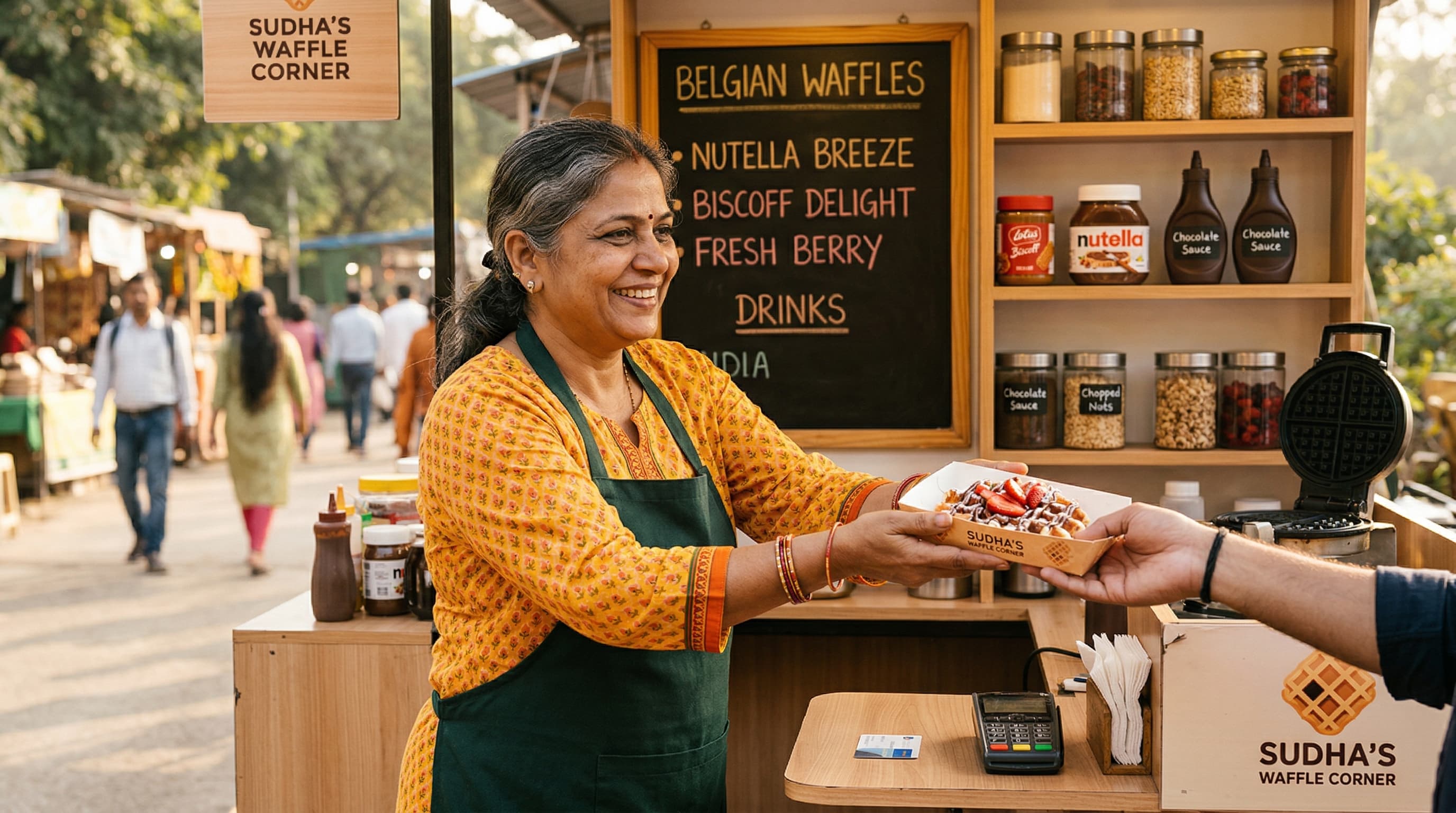
Most business advice in India assumes you are a 25-year-old single man willing to work 14 hours a day, sleep in the backroom of your shop, and put your entire life on hold for three years.
That is not most people.
Most people have families. Elderly parents. School pickups. Household responsibilities. A full-time job they cannot quit. Health considerations. Maybe they have raised children, built a home, and now, in their 30s, 40s, or 50s, they want something of their own. Something that earns money without swallowing their entire life.
Those people are some of the best franchise owners we have.
This guide is for them.
The Gap Nobody Talks About
Search "small business ideas for housewives in India" on any forum and you will see the same tired suggestions: tiffin service, tuition classes, papad-making, handmade crafts on Meesho, reselling on WhatsApp.
These are all legitimate. Some of them even work. But most of them share the same ceiling, they cap out at Rs 15,000-25,000 a month, and they put 100% of the operational load on the founder. If you get sick, the business stops. If you travel for a wedding, income drops to zero that week.
A franchise kiosk is a different category. It keeps earning whether you are physically there or not, because the brand has already built the system that runs without you. You become a manager, not a one-person production line.
And at the Rs 4 lakh entry level for a kiosk, which is where TBWX starts, it is one of the very few business categories where a housewife or retiree can own something meaningful without betting the family savings. If cost is a primary concern, see how TBWX stacks up as the most accessible food franchise entry point in India.
What 5 Hours a Day Actually Looks Like
The most common question we get from housewives and retirees is: "Do I have to be there all day?"
The honest answer: no, but you have to be there at the right hours.
Here is a typical day at a TBWX outlet where the owner runs it as a part-time business:
| Time | What is Happening | Owner's Role |
|---|---|---|
| 10:00 - 11:00 AM | Opening, stock check, cleaning | Optional. Trained staff can handle. |
| 11:00 AM - 1:00 PM | Lunch-hour rush (mall locations) | Ideal owner presence. 2 hrs |
| 1:00 - 4:00 PM | Lean period | Not required. Staff runs the outlet. |
| 4:00 - 7:00 PM | Evening rush (critical) | Ideal owner presence. 3 hrs |
| 7:00 - 10:00 PM | Peak dinner + dessert crowd | Optional. Trusted senior staff can close. |
| 10:00 - 10:30 PM | Closing, cash deposit | Optional. Daily reports on WhatsApp. |
Total owner time on the floor: 4-5 hours, covering the two rush periods. The rest of the day is either lean (staff manages) or outside your direct presence.
For a housewife, this often means: school drop at 8, household chores until 10, kiosk from 11 to 1 during lunch rush, home for lunch and school pickup, back at the kiosk 5 to 7 for the evening peak. Home by 8 for dinner with family. This is a schedule thousands of Indian women already manage with their other work. It is not exotic.
What the Brand Does So You Do Not Need Restaurant Experience
The single biggest fear we hear from first-time owners, especially women, is: "But I have never worked in a restaurant. I cannot manage a kitchen."
You do not need to. This is what the TBWX system replaces:
You do not need to design a menu. We have done that. Over 40 waffles, cones, croffles, shakes, all tested across 67 outlets, all with detailed SOPs.
You do not need to train staff from scratch. We run the training. Your staff arrives at your outlet already knowing how to make every item on the menu.
You do not need to build a supply chain. Ingredients are delivered by our regional supply partners on a scheduled rotation. No negotiating with vendors. No chasing invoices.
You do not need to do the marketing. Our brand HQ runs the main Instagram, website SEO, ad campaigns, and seasonal promotions. Your job is the local layer. Google Business reviews, WhatsApp to regulars, one or two reels a week.
You do not need to handle the software or POS. Our integrated POS is pre-installed. Daily reports are automatic.
You do not need to handle legal setup. We guide you through FSSAI, GST, trade licence, and society/shop licence in the first 10 days.
What is left for you? The human parts. Greeting customers, supervising quality during your hours, managing staff schedules, and keeping an eye on daily numbers. Things most housewives already do for their families, except now they get paid for it.
The Financial Picture Honestly
Here is what a TBWX kiosk realistically earns across the two most common part-time ownership scenarios:
| Scenario | Owner Hours/Day | Staff Cost | Monthly Revenue | Monthly Take-Home |
|---|---|---|---|---|
| Hands-on (5 hrs) | 5 | Rs 12,000 (1 helper) | Rs 1,20,000 - 1,50,000 | Rs 32,000 - 45,000 |
| Managed (2 hrs) | 2 | Rs 22,000 (2 staff) | Rs 1,30,000 - 1,60,000 | Rs 20,000 - 30,000 |
The managed model takes home less, because you are paying someone else to do the hours you are not there. That is the trade-off. More freedom, less margin. Both models work. The right one depends on your life stage, not your ambition.
Read the full TBWX investment breakdown if you want the complete cost-to-open picture.
The Family Support Conversation
Let us be honest about the hardest part of starting a franchise as a housewife or retiree in India: convincing your family.
Spouses worry about the money. Parents worry about the reputation. Siblings worry about the risk. In-laws worry about the time taken away from household duties.
The answer to all of them is the same: evidence, not argument.
Show them the cost sheet. Rs 4 lakh is not a life-altering figure. It is less than a mid-range car.
Show them the time structure. 4-5 hours a day is compatible with any household.
Show them the real owner stories, especially the ones who look like you.
Offer them a small role. Many husbands and adult children who initially opposed their wife or mother opening a kiosk eventually became the weekend supervisor, the social media helper, or the finance tracker.
A family business works better when the whole family has a small role in it. That is not a compromise. That is how Indian businesses have survived for centuries.
Common Concerns, Answered Honestly
"What if I fall sick or need to travel?" Your trained staff run the outlet. That is the whole point of a system-based business. A TBWX outlet has survived 10-day owner absences. It cannot survive 30-day absences without someone checking in, but that is true of any business.
"What if my children need me in an emergency?" The outlet will still be open, because your staff will be there. You can leave whenever you need to. This is the biggest advantage over, say, a tiffin service, where the business stops the moment you stop.
"I am not comfortable handling staff." We train you on basic team management in the onboarding. Most of our women owners learn it by month three. It is a learnable skill, not a personality trait.
"My husband doesn't want me to work a retail job." This is not a retail job. You are the owner, not an employee. You set the hours. You take home the profits. You make the decisions. It is closer to being a CEO of a very small business than being a shop assistant. That framing alone changes many family conversations.
"What if the business fails?" Read what happens if your franchise fails. There are legitimate exit options. Your investment is not locked in a trap.
A Note For the Women Reading This Who Were Told They Should Not Do This
We have had applicants hide their franchise application from their families until the outlet was almost open, because they were afraid of being told no. We have seen daughters fund their mothers' first business. We have seen retired aunties sign onto WhatsApp for the first time to manage their kiosk's customer list.
You are not too old. You are not too inexperienced. You are not behind. You are exactly on time.
The Rs 4 lakh kiosk is the smallest possible serious business you can start in India in 2026. It is not a toy. It is not a hobby. It is a real, profitable, scalable business that happens to be small enough to start without risking your entire life.
If you want to go deeper, read our dedicated guide for women entrepreneurs starting a franchise, it covers financing, family conversations, and real owner stories in more detail. Or apply as a TBWX franchise partner directly. Our team will take the time to understand your life situation before recommending whether this is the right fit for you. We say no to people the model does not suit. We are not trying to sell you anything you should not buy.
But if it is the right fit, and for thousands of women across India, it is, this is the path.